VIPERS Reading Explained for Parents
Your child's school mentioned VIPERS. Here's what it means in plain English — and exactly how to help at home tonight, without stress.
Aligned with the UK National Curriculum. Written for parents, not teachers.
Help with VIPERS tonight — 3 questions to ask during reading
You don't need to understand the whole framework to help your child. These three questions cover the skills teachers care about most.
“What do you think this story is about?”
Looks at the cover, title or first page. This is what teachers call Prediction. No wrong answer — you're warming up their brain.
“How do you think the character is feeling?”
Then add “How do you know?” Teachers call this Inference, and it's the hardest skill in SATs. Follow-up question is the whole point.
“What was the most important bit?”
This is Summarise. If they list every detail, that's a sign they're decoding but not understanding — which is what VIPERS is designed to catch.
The real parent question: are they behind?
If your child answers the Inference question with a blank stare, that's normal — it's the skill most Year 3–6 children struggle with. If it happens every time across several weeks, it's worth checking their overall reading level.
Check your child's reading age →VIPERS question stems you can print tonight
Free parent-friendly card with questions for every skill, by year group.
Stories at your child's level, about what they love
VIPERS questions are built in. 3 free stories — no card required.
Want your child to practise VIPERS skills at home?
Primary Story creates personalised reading stories with built-in comprehension questions, so your child can practise retrieval, inference and vocabulary without another worksheet.
What does VIPERS actually stand for?
If you want the full picture behind the three questions above — here's the acronym, what each letter means, and why UK primary schools use it.
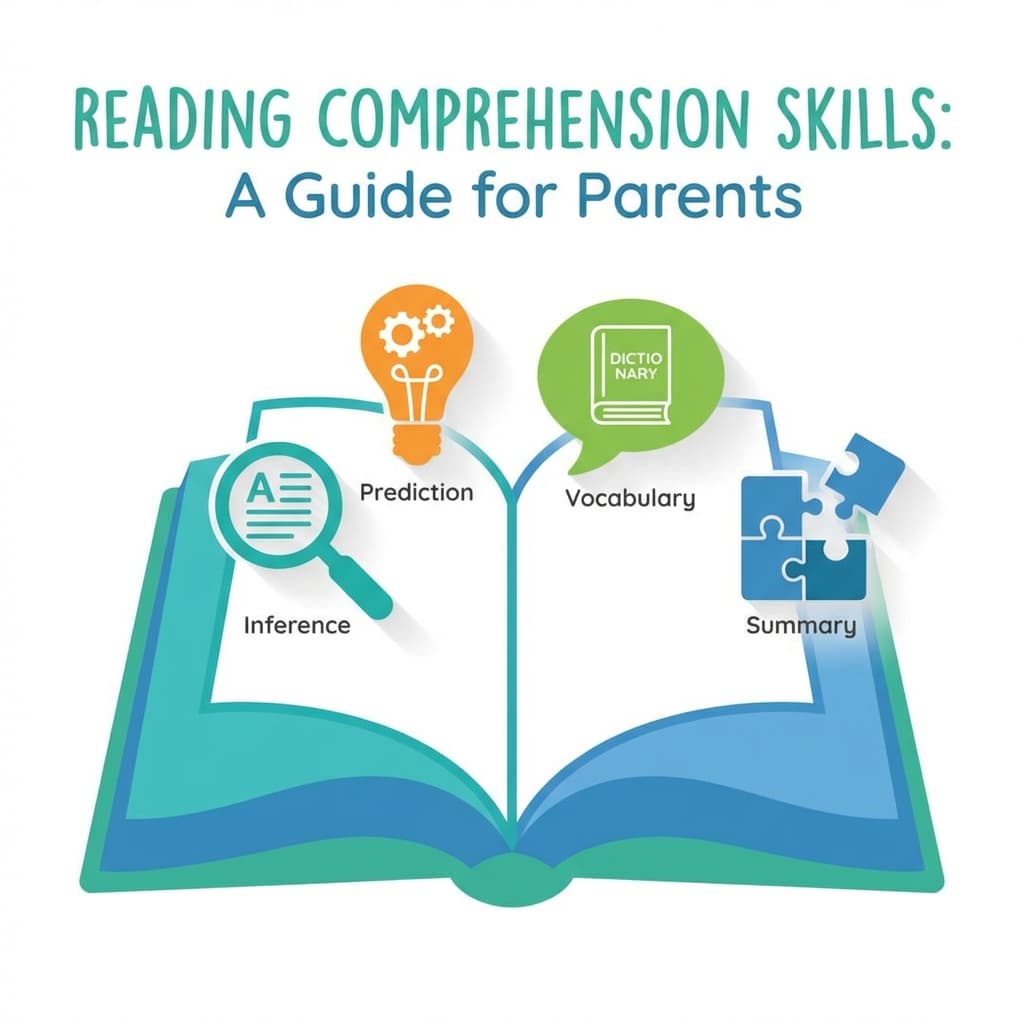
VIPERS is an acronym representing six key reading comprehension skills taught throughout primary school in the UK. Developed to align with the National Curriculum, VIPERS provides teachers, parents, and students with a clear framework for understanding and practicing all aspects of reading comprehension—not just decoding words, but truly understanding texts.
Before VIPERS, comprehension teaching could be inconsistent, with some skills (like retrieval) practiced more than others (like inference or summarizing). VIPERS ensures systematic coverage of all six domains, making sure children develop well-rounded comprehension abilities.
The framework is used from Key Stage 1 (Years 1-2) through Key Stage 2 (Years 3-6), with skills becoming progressively more sophisticated. By Year 6, children answering VIPERS questions are fully prepared for SATs reading papers, which test all six domains.
Why Schools Use VIPERS
- Systematic coverage: Ensures all comprehension skills are taught, not just favorites
- National Curriculum alignment: Directly maps to curriculum objectives for reading
- Clear assessment: Easy to identify which specific skills need more practice
- SATs preparation: All VIPERS skills are tested in Year 6 SATs reading papers
- Consistent language: Children, teachers, and parents use the same terminology
How VIPERS Aligns to the National Curriculum
The UK National Curriculum for English requires children to develop comprehension skills across multiple domains. VIPERS organizes these requirements into six memorable categories:
- Curriculum objective: "Check that the text makes sense... discussing their understanding"
- VIPERS equivalent: Retrieve (finding information), Summarise (discussing understanding)
- Curriculum objective: "Draw inferences such as inferring characters' feelings, thoughts and motives"
- VIPERS equivalent: Inference (reading between the lines)
Every National Curriculum comprehension objective maps to at least one VIPERS domain, ensuring complete coverage.
The 6 VIPERS Skills Explained
Each domain develops a different aspect of reading comprehension
Vocabulary: Understanding Word Meanings in Context
Vocabulary questions test whether children understand what words mean in the context of the text. It's not just about knowing dictionary definitions—it's about figuring out meanings from surrounding sentences, recognizing synonyms, and understanding how word choices create effects.
Example Questions:
- "What does the word furious mean in this sentence?"
- "Find and copy a word that means the same as happy."
- "What impression does the word whispered create?"
Why It Matters:
Strong vocabulary is the foundation of comprehension. Children who understand more words read more fluently, access harder texts, and perform better on all other VIPERS skills. Vocabulary questions also teach children to use context clues rather than stopping to look up every unfamiliar word.
Inference: Reading Between the Lines
Inference is often the hardest VIPERS skill. It requires children to understand what's implied but not directly stated—reading between the lines to deduce feelings, motivations, themes, or meanings. Good readers automatically infer; weaker readers struggle because they focus only on literal meanings.
Example Questions:
- "How do you think the character felt at this moment? Use evidence from the text."
- "Why do you think the character made that decision?"
- "What does this sentence suggest about the setting?"
Why It Matters:
Inference separates basic readers from strong readers. It's the skill that lets children understand subtext in stories, empathize with characters, and grasp themes. Inference questions are heavily weighted in Year 6 SATs. Regular practice with explanations showing how to infer gradually builds this critical skill.
Prediction: What Might Happen Next
Prediction questions ask children to use clues from the text to anticipate what might happen next. Good predictions are evidence-based, not wild guesses. Children learn to spot foreshadowing, notice patterns, and use their knowledge of story structure and character behavior.
Example Questions:
- "What do you think will happen next? Explain your answer using the text."
- "From reading this paragraph, what do you think the character will do?"
- "What clues suggest how the story might end?"
Why It Matters:
Prediction keeps children engaged with stories—they become active readers, not passive consumers. It teaches cause-and-effect thinking and pattern recognition. In real life, predicting helps children anticipate consequences, plan ahead, and understand how events connect. Prediction questions also assess whether children understand story structure and character development.
Explain: Justify Answers with Evidence
Explain questions require children to justify their answers with evidence from the text. This might mean explaining how they know something, why the author made a choice, or how language creates effects. Explain questions demand higher-order thinking and detailed responses.
Example Questions:
- "Why did the author use the word crept instead of walked?"
- "Explain how this paragraph makes the reader feel tense."
- "Why is this an effective opening to the story?"
Why It Matters:
Explain questions develop analytical thinking and teach children to support opinions with evidence—skills used throughout secondary school and adult life. In SATs, Explain questions are worth more marks and separate higher-achieving students. Children learn to think like writers, understanding how texts work, not just what they say.
Retrieve: Find Information in Text
Retrieve questions are the most straightforward—children find and extract information directly stated in the text. This tests whether children can scan text efficiently, locate specific details, and accurately copy or paraphrase information. It's the foundation before tackling more complex skills.
Example Questions:
- "What color was the character's coat?"
- "Where did the story take place?"
- "How many children were at the party?"
Why It Matters:
While retrieve seems simple, it's essential for building reading stamina and attention to detail. Children who struggle with retrieval often read too quickly without paying attention. Strong retrieval skills also support inference—you must notice stated facts before inferring unstated meanings. In SATs and secondary school, retrieval is the foundation for evidence-based answers.
Summarise: Identify Key Themes
Summarise questions assess whether children can identify main ideas and key information across paragraphs or entire texts, ignoring unimportant details. Summarizing requires understanding the "big picture"—themes, central messages, and overall meaning—not just isolated facts.
Example Questions:
- "What is the main theme of this story?"
- "Summarize the character's journey in three sentences."
- "What are the three most important events in this chapter?"
Why It Matters:
Summarizing is crucial for handling longer texts—chapter books, non-fiction articles, exam papers. Children who can't summarize get lost in details without understanding overall meaning. Summarizing also supports memory (remembering key points, not every word) and helps with planning written work. It's tested throughout SATs and essential for secondary school learning.
What parents do after learning about VIPERS
They let their child try a story with real VIPERS questions — with instant feedback on each skill.
VIPERS Skills Development by Year Group
How each skill progresses from Year 1 to Year 6
Key Stage 1: Years 1-2 (Ages 5-7)
Early readers focus on simple, concrete skills. Questions use straightforward language and focus on literal understanding with some basic inference.
- Vocabulary: Understanding common words, matching words to pictures
- Inference: Simple feelings ("Is the character happy or sad?")
- Prediction: Basic "What might happen next?" with picture clues
- Explain: "How do you know?" with one-sentence answers
- Retrieve: Finding explicitly stated facts ("What color is...?")
- Summarise: Retelling stories in sequence, identifying main characters
Lower Key Stage 2: Years 3-4 (Ages 7-9)
Children tackle longer texts and more complex questions. Inference becomes more important, moving beyond obvious feelings to motivations and themes.
- Vocabulary: Using context clues, exploring word families, understanding figurative language
- Inference: Character motivations, understanding subtext, inferring from actions
- Prediction: Evidence-based predictions using multiple clues from the text
- Explain: Explaining simple language choices, identifying effective descriptions
- Retrieve: Scanning longer texts, finding information across multiple paragraphs
- Summarise: Identifying main ideas in paragraphs, summarizing chapter events
Upper Key Stage 2: Years 5-6 (Ages 9-11)
Advanced comprehension requires analyzing language, understanding author's purpose, and making connections across texts. Year 6 ends with SATs testing all domains.
- Vocabulary: Sophisticated word meanings, analyzing how word choice creates tone and atmosphere
- Inference: Complex inference about themes, symbolism, and implied meanings across texts
- Prediction: Nuanced predictions considering character development and foreshadowing
- Explain: Analyzing author's viewpoint, purpose, and how structure affects reader
- Retrieve: Extracting information from complex non-fiction, comparing sources
- Summarise: Identifying themes across entire books, synthesizing information from multiple texts
How Primary Story Teaches All 6 VIPERS Skills
Comprehensive, systematic VIPERS practice with every story

Every Story Includes All 6 VIPERS Domains
After reading each AI-generated story, children answer 10-15 comprehension questions covering all six VIPERS skills. Questions are mixed (not grouped by type), mirroring real SATs papers where children must identify which skill each question requires.
- Balanced coverage—no skill is neglected
- Age-appropriate question complexity for each year group
Instant Feedback with VIPERS Explanations
When children answer questions, they receive immediate feedback showing the correct answer and—critically—explaining why. Explanations reveal the thinking process behind each VIPERS skill, helping children internalize comprehension strategies.
- Learn how to infer, not just get answers right
- Understand why certain evidence supports answers
VIPERS Progress Tracking
The Parent Dashboard shows performance broken down by VIPERS domain, making it easy to identify which specific skills need more practice. See at a glance whether your child excels at Retrieval but struggles with Inference, or vice versa.
- Accuracy by domain: Percentage correct for each VIPERS skill
- Trend analysis: See improvement over time in weak areas
- Targeted practice: Focus on skills that need development
Example VIPERS Accuracy Report
Insight: Focus on Inference practice—this child retrieves facts well but needs help reading between the lines.
VIPERS Practice Strategies for Parents & Teachers
How to support VIPERS development at home and in the classroom
For Parents: Daily VIPERS Practice
You don't need to plan formal lessons—integrate VIPERS questions naturally during reading time:
Want a structured approach? Our parent-friendly VIPERS practice guide includes a 5-day practice plan, free question stems, and progress tracking sheets.
If your child understands VIPERS but resists reading practice altogether, the problem is usually motivation rather than ability. Our guide on reluctant readers covers exactly how to rebuild engagement — including how to get VIPERS practice in without it feeling like homework.
- Before reading: Prediction—"What do you think this story will be about based on the title?"
- During reading: Inference—"How is the character feeling right now?"
- After reading: Summarise—"What was the main message?"
For Teachers: Structured VIPERS Lessons
Use VIPERS to structure whole-class reading comprehension:
- Domain focus days: Monday = Inference, Tuesday = Vocabulary, etc., ensuring systematic coverage
- Display VIPERS posters: Visual reminders showing question starters for each domain
- Model thinking aloud: Show how you infer or explain, not just what the answer is
- Use Primary Story for homework: Children practice independently with instant feedback, freeing teacher time for targeted support
Common VIPERS Mistakes to Avoid
- ❌
Over-focusing on Retrieve
Don't just ask factual questions—they're easiest but least valuable for developing comprehension
- ❌
Accepting guesses for Inference
Always ask "How do you know?" or "What makes you think that?"—inference needs text evidence
- ❌
Labeling VIPERS during SATs practice
Real exams don't label questions as "Inference" or "Retrieve"—children must identify skill needed
- ❌
Neglecting Explain & Summarise
These higher-order skills separate strong readers and are heavily weighted in SATs
VIPERS practice doesn't have to feel like a worksheet
Your child picks a topic they love. We generate a story at their level with all 6 VIPERS skills built in — so comprehension practice feels like reading a good story.
VIPERS: Parent Questions Answered
The things parents actually ask when their child comes home with VIPERS homework
VIPERS is a reading comprehension framework used in UK primary schools to help children develop six key reading skills. VIPERS stands for: Vocabulary (understanding word meanings), Inference (reading between the lines), Prediction (what might happen next), Explain (justify answers with evidence), Retrieve (find information in text), and Summarise (identify key themes). This framework aligns with the UK National Curriculum and ensures children develop all aspects of reading comprehension, not just literal understanding.
UK schools use VIPERS because it provides a systematic, comprehensive approach to teaching reading comprehension aligned with National Curriculum objectives. The framework ensures teachers cover all required comprehension skills, makes assessment easier by breaking skills into clear categories, helps identify specific areas where children need support, and provides a consistent approach from Key Stage 1 through Key Stage 2. VIPERS questions appear throughout SATs reading papers, making it excellent exam preparation while developing genuine comprehension skills.
The 6 VIPERS skills are: 1) Vocabulary - understanding what words mean in context, exploring word choices, and expanding word knowledge. 2) Inference - reading between the lines, understanding implied meanings, and deducing character feelings or motivations. 3) Prediction - using clues from the text to anticipate what might happen next, based on evidence. 4) Explain - justifying answers with evidence from the text, explaining author's choices and how language creates effects. 5) Retrieve - finding and extracting specific information directly stated in the text. 6) Summarise - identifying main ideas, themes, and key information across paragraphs or whole texts.
VIPERS skills develop progressively from Year 1 to Year 6. Early years (Y1-2) focus on simple retrieval, basic prediction, and discussing obvious feelings. Mid-primary (Y3-4) adds inference of character emotions, explaining simple language choices, and summarizing paragraphs. Upper primary (Y5-6) requires complex inference across texts, analyzing sophisticated vocabulary, explaining author's viewpoint and purpose, predicting with nuanced evidence, and summarizing themes across multiple chapters. Questions become longer and more complex, requiring detailed written explanations rather than single-word answers.
Primary Story integrates all 6 VIPERS domains into every story. After reading, children answer mixed VIPERS questions covering vocabulary in context, inference about characters and themes, predictions based on story events, explanations with text evidence, retrieval of key facts, and summarising main ideas. Each question includes instant feedback showing the correct answer and explaining why, helping children understand the thinking process behind each VIPERS skill. The Parent Dashboard tracks performance by VIPERS domain, highlighting which skills need more practice.
Vocabulary: 'What does the word furious mean in this sentence?' Inference: 'How do you think the character felt when...? Use evidence from the text.' Prediction: 'Based on what you have read, what do you think will happen next?' Explain: 'Why did the author use the word crept instead of walked?' Retrieve: 'What color was the character's hat?' Summarise: 'What is the main theme of this story?' or 'Summarize the character's journey in three sentences.' Each skill requires different thinking processes, from simple text scanning (retrieve) to complex analysis (explain).
Practice VIPERS at home by asking varied questions when reading together. For Vocabulary, ask 'What does this word mean?' For Inference, 'How is the character feeling? How do you know?' For Prediction, 'What clues tell us what might happen?' For Explain, 'Why did the author describe it this way?' For Retrieve, 'Can you find where it says...?' For Summarise, 'Tell me the three most important things that happened.' Primary Story provides ready-made VIPERS questions for every story, removing the planning burden while ensuring comprehensive coverage.
Yes, VIPERS is a framework for teaching and assessing reading comprehension—it's not a separate skill. Reading comprehension means understanding what you read beyond decoding words. VIPERS breaks comprehension into six distinct skill areas, making it easier to teach, practice, and assess. Before VIPERS, teachers covered comprehension less systematically. VIPERS ensures no skill is neglected. When your child practices 'comprehension questions,' they're likely answering VIPERS questions, whether explicitly labeled or not. The framework simply organizes the skills children need to fully understand texts.
Year 6 SATs reading papers are structured around VIPERS skills, though questions aren't labeled as such. The exam tests all six domains: vocabulary questions ask for word meanings, inference questions require reading between lines, explain questions assess understanding of language choices and author's purpose, retrieve questions find stated facts, and summarize questions identify themes. SATs mark schemes use VIPERS language in assessment criteria. Practicing VIPERS throughout primary school ensures children are SATs-ready without separate 'exam skills' training—they've been developing tested competencies all along.
It's completely normal for children to excel at some VIPERS skills while struggling with others. Most children find Retrieve easiest (finding stated facts) and Inference hardest (reading between the lines). Primary Story's Parent Dashboard shows performance by VIPERS domain, helping you identify specific areas needing practice. Focus practice on weaker skills while maintaining stronger ones. Inference and Explain typically need the most practice since they require higher-order thinking. Regular exposure to all six domains, with explanations showing the reasoning process, gradually strengthens weaker areas.
Still have questions?
Contact SupportWhat parents do after learning about VIPERS
They let their child try a story with real VIPERS questions — with instant feedback on each skill.
Try a VIPERS Story With Your Child
Create a personalised story with all 6 VIPERS skills — instant feedback shows exactly what they understand
Free account • All 6 VIPERS skills covered
Practise VIPERS with stories by year group: