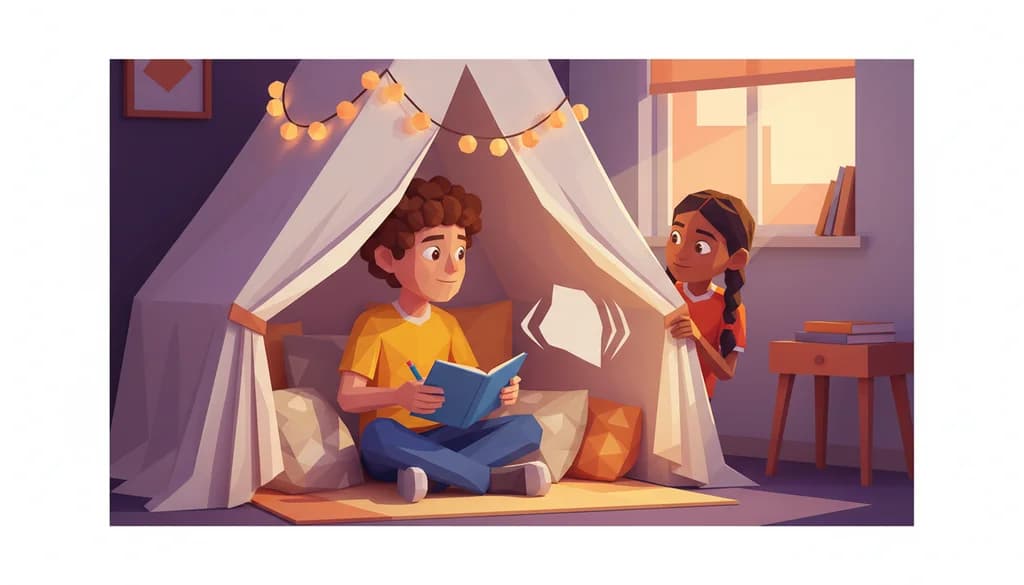
Jenius adjusted the bedsheet ceiling of his bedroom fort, letting a stripe of golden afternoon light slide across the carpet. Inside the fort, the world felt smaller and brighter at the same time. Crayons lay in neat rows, a plate of apple slices waited on a tray, and a cardboard sign announced in careful marker letters: INVISIBLE CLUB – MEMBERS: JENIUS AND LARK.
“Apple slice, Captain Lark?” Jenius asked the empty cushion opposite him.
In his mind, Lark bowed in a shimmering blue coat and replied in a squeaky, excited voice Jenius had invented, “For science power, obviously.”
Jenius smiled. At school, people said hello to him, but no one stayed long. He often felt like a pencil left at the edge of a desk—useful, but easy to forget. Here with Lark, he never felt invisible.
A soft knock came at his door. “Jenius? It’s Priya from next door,” called a voice.
Priya stepped in, eyes widening at the glowing fort and the sign. “Wow,” she breathed. “This looks like a real club.” She hesitated. “Um, who’s Lark?”
Jenius’s ears warmed. “Just… someone I talk to,” he said quietly.
Priya didn’t giggle or tease. She crouched by the entrance. “Can I join? I’m new on Maple Street. Sometimes I feel invisible too. Maybe your club could use another member you can actually high-five?”
Jenius glanced at the empty cushion. In his mind, Lark shrugged and did a tiny cartwheel.
A knot of worry pulled in Jenius’s chest. What if letting Priya in made Lark fade, like chalk in the rain? The Invisible Club was the one place he knew exactly who he was.
He took a slow breath and thought about his choices. Keeping things the same felt safe but lonely. Changing the club felt strange, but it might also mean something new.
“Okay,” Jenius said at last. “Rule number one of the Invisible Club: everyone who feels unseen is welcome.”
Priya’s grin lit the whole fort as she crawled inside.
By the next Saturday, the Invisible Club had grown again.
Priya arrived with a quiet boy beside her. He wore a hoodie a size too big and held a sketchbook to his chest like a shield.
“Jenius, this is Mateo,” Priya said. “He’s in our year, but our class hardly notices him. I thought… maybe that means he can join?”
Mateo gave a small, hopeful wave.
Inside the fort, Jenius announced, “Invisible Club meeting number three.” He slid the apple slices to the centre and added a new rule to the poster: SHARE SNACKS. SHARE STORIES.
He described Lark properly this time, from the wild hair to the endless questions. Mateo listened, then opened his sketchbook. On the page, he had drawn a tiny figure in a swirling coat, racing between stars.
“I drew how I imagine Lark,” Mateo said.
Jenius’s heart gave a happy jump. No one had ever joined in with his imagination before.
At school, the three of them claimed the sunny patch under the big maple tree at recess. Chalk diagrams spread over the pavement as they hosted their first Invisible Inventions Fair.
“Lark is running a secret science lab,” Jenius explained, drawing arrows. “We’re testing how to notice invisible things—like feelings.”
Priya added speech bubbles and labelled levers with words like SENSOR and DATA. Mateo carefully shaded a cardboard machine with dials that, in their story, could notice when someone felt lonely.
A couple of classmates wandered over, curious. “What are you doing?” one asked in a friendly voice.
Priya answered, “We’re designing inventions to notice people who get ignored. It’s for our Invisible Club.”
The others traded puzzled but kind looks. “Cool,” someone said, before jogging back to the football game.
Mateo watched them go, then stared at the chalk machine. “Sometimes I feel like that,” he admitted. “Like I’m standing right there, but people look past me.”
Jenius felt a pull in his chest. It was exactly how he had felt before Lark.
He thought about it carefully, then wrote in chalk: RULE TWO – NEVER LET ANYONE SIT ALONE.
He noticed Mateo’s shoulders loosen, just a bit, as if the words were a warm cloak around him.
A week later, their teacher, Mr. Harris, clapped his hands at the front of the busy classroom. Cardboard, glitter, and string were piled on every table.
“Your challenge,” he said, smiling, “is to design a model machine that makes the world kinder. Work in groups. Think carefully about how your design will help people.”
Voices filled the room as children formed groups. For the first time, a table of popular classmates waved Jenius over.
“Hey, Jenius,” called Aiden, smiling. “You’re really good with ideas. Want to join us? We’re building a Compliment Cannon.”
Jenius froze, pencil mid-tap. Being wanted, out loud, felt bright and exciting.
From the corner he heard Priya. “We saved you a seat, Jenius.” She and Mateo had gathered boxes and coloured paper, leaving a space beside them. Mateo’s drawing of the invisible machine from the playground lay on the desk.
“Just a second,” Jenius told them. In his imagination, Lark tugged his sleeve.
At Aiden’s table, ideas flew everywhere. They talked over one another, planning how shiny their project would look in assembly. No one asked what Jenius thought. For a moment, he pictured himself there: laughing, easy, with no questions about invisible friends.
Then he glanced back.
Priya’s hands rested, still, on a half-built cardboard frame. Mateo sat very straight, as if bracing for bad news he already expected. Between them lay the start of their own design, left half-finished: a tall structure with tissue-paper wires, labelled FRIENDSHIP FINDER.
A quiet thought rose inside Jenius. If he stayed with Aiden, Mateo might feel as invisible as Lark. His new friends were the ones who had noticed him first.
He imagined the two choices side by side, like two pictures, and tried to see which one felt right. One choice made him look impressive. The other choice meant standing beside the people who had stood beside him.
His chair at Aiden’s table scraped softly as he stood.
“Sorry,” Jenius said, keeping his voice gentle. “I already have a team.”
He walked back to Priya and Mateo. His heart thumped fast, but it also felt steady, like it knew the way.
Priya searched Jenius’s face as he slid into the empty chair. “Are you sure?” she whispered.
“I’m sure,” Jenius said. “Rule number three of the Invisible Club: we don’t hide our friends.” He took a breath. “That includes Lark.”
For the first time at school, he spoke about Lark out loud, not just as a secret. He told them how Lark asked brave questions and tried strange experiments.
“So Lark’s part of our group too,” Jenius finished. “We’re a team of four.”
Mateo smiled, small but real. “Then our machine needs four seats,” he said, and he drew tiny silhouettes on their cardboard model.
Together they built the Friendship Finder: a tall cardboard tower with paper-towel-tube tunnels and strings for levers. Priya added coloured “sensors” made of tissue paper.
“When someone nearby feels lonely or unseen,” she explained, “the sensors pick up that feeling like a message.”
“And then,” Jenius added, “it lights up and sends a gentle signal that says, ‘Come sit with us.’ No one has to stay on the edge of the playground.”
Mateo taped on a sign: FOR ANYONE WHO’S EVER FELT INVISIBLE.
During the school assembly, projects lined the hall like a busy display. Classes wandered past cardboard robots and glittery cannons.
When they reached the Friendship Finder, Jenius felt a nervous flutter in his stomach. Their machine looked a little odd, held together with tape and hope.
Mr. Harris read their description aloud. “This group designed a machine that notices people who feel invisible, including imaginary friends. It only works when everyone nearby chooses to include each other.”
There was a pause.
“I’d like that on the playground,” someone said.
“Me too,” another voice added. “Sometimes I feel invisible, even with lots of people around.”
Aiden looked at Jenius with honest respect. “Your idea is really smart,” he said. “Maybe we could be Friendship Finders for real.”
Warm relief washed through Jenius. In his mind, Lark swung from the paper-towel tubes, laughing.
After school, they walked home under the real maple tree. Priya linked her arm through Jenius’s. Mateo matched his steps to theirs.
“Do you think the Friendship Finder really works?” Mateo asked.
Jenius thought for a moment, then nodded. “I think it already did. We just had to stop hiding the people—and the ideas—that mattered.”
In his mind, Lark’s voice was clear. “Observation,” the invisible friend said. “Real friendship doesn’t have to be invisible at all.”
Jenius smiled, feeling truly noticed and accepted, and held his friends’ arms a little tighter as they headed down Maple Street together.
