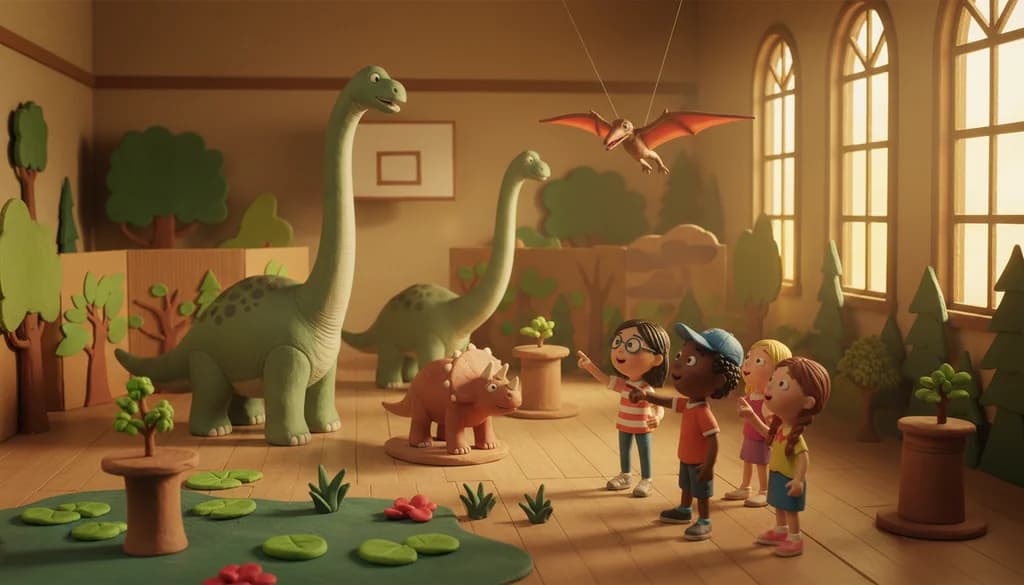
Lenny stood in the middle of the school gym, hardly remembering to breathe. Overnight, it had transformed into a “Dino Ages” hall. Cardboard trees towered beside painted lava flows, and a mist machine puffed over a fake swamp. The air smelled like popcorn from the canteen.
Above everything, a metal frame held the school’s pride: the Triassic Simulator. Triassic was one of the earliest dinosaur times. Silver projectors pointed down like metal dragonflies, ready to beam dinosaur worlds into the room.
“This is it,” Lenny whispered. “Real science.” Everyone already knew he adored dinosaurs, but he wanted them to see he could think like a scientist too, not just shout out every dinosaur name at lunch.
Dr. Arroyo, their science teacher, checked the control tablet. “We’ll start with simple holograms—see‑through dinosaur pictures,” she said. “Remember, we’re showing history, not changing it.”
Lenny’s best friend Mei, who preferred modern birds to “scaly monsters,” nudged him. “You look like you’re about to time‑travel for real.”
“I just want it to be… perfect,” Lenny admitted.
Quietly, while Dr. Arroyo greeted the class, he stepped behind the control table. A tiny slider read: Projection Density—a control that made the holograms thicker and more solid.
He imagined giant sauropods brushing the ceiling and chicken‑sized dinosaurs weaving between sneakers. If the dinosaurs looked almost real, no one would ever call this a babyish slideshow.
He swallowed, then nudged the slider up.
The gym lights dimmed. Safety lights flashed yellow. The projectors hummed louder.
“Uh… Dr. Arroyo?” Lenny called.
Before she could answer, shimmering shapes rained from the beams—then thickened. A gentle weight shook the floor as something huge landed. Holograms weren’t supposed to shake floors.
Now everyone stared. A long‑necked sauropod blinked politely at the basketball hoop. Nearby, a duck‑billed dinosaur sniffed a toppled poster. Chicken‑sized dinosaurs with bright eyes examined shoelaces, tilting their heads like curious birds.
Dr. Arroyo stepped forward, voice steady. “Class, they seem peaceful and very puzzled. We will be calm too. Lenny, what did you adjust?”
Heat rushed into Lenny’s cheeks. “Only the projection density. I wanted people to see more details.”
Dr. Arroyo’s eyes were serious but kind. “Science means thinking about what might happen next, not just what looks cool. Now we’ll work together as a team to keep everyone—past and present—safe.”
They discovered the Simulator had divided the gym into dinosaur time zones. On one side, a Triassic forest shimmered, labeled: OVER 230 MILLION YEARS AGO. Next came a Jurassic swamp, from the middle dinosaur ages. Closest to the exit, a Cretaceous desert scene glowed with painted sand and small trees from the last dinosaur age. Dinosaurs from each era had been dropped wherever there was space.
“We need to sort out which animals belong where,” Lenny said slowly. “Their fossils tell us which place fits them.”
Mei pointed at a feathery, small theropod—a meat‑eating dinosaur with bird‑like legs—perched nervously on a climbing frame. “That one moves like a sparrow,” she murmured.
She puffed her cheeks, gave a soft whistle, and tilted her head the way she had seen birds do.
To everyone’s amazement, the little dinosaur copied her, relaxing its shoulders and hopping closer.
Working together, Lenny, Mei, Jonah, and the twins Lila and Ben gently guided each dinosaur toward its matching zone with colored banners, soft voices, and trays of lettuce and fruit.
Halfway through, the air flickered. The sauropod’s tail turned see‑through for a second.
In the timeline corridor outside the gym, fossils in the display cases were turning pale and blurry, as if someone was rubbing them out with a giant eraser.
“Our dinosaur history is starting to fade away like an old picture,” Dr. Arroyo said quietly. “If these animals stay, their past will disappear.”
Back in the simulator room, the projectors buzzed anxiously. The forest scene bled into the swamp; desert colors leaked across the basketball court. In the center of the gym, a swirling, map‑like portal formed on the floor, glowing with rivers of light that twisted into the shapes of continents.
“A portal is like a special doorway,” Dr. Arroyo explained quickly, tapping the tablet. “The reset needs a guide inside the projection field. Someone must lead the herd through that glowing gateway so history snaps back into place.”
“I’ll do it,” Lenny said, before he could overthink. After all, he had caused this.
He stepped onto the trembling simulator stage. The air smelled faintly of rain and warm dust, like a storm in a museum. Dinosaurs clustered around him, eyes wide.
The duck‑billed Cretaceous dinosaur—the one that had been sniffing posters—pressed its soft snout into his palm. Its eyes were thoughtful and gentle.
Lenny imagined keeping it here forever, introducing it at show‑and‑tell, measuring its footprints for the science fair. His name would be in every textbook.
Then he pictured the blank fossils, the empty corridor, the dinosaur chapters with nothing in them.
“If you stay,” he whispered to the duck‑bill, “millions of years vanish. That’s not fair to your time.”
The portal flickered, shrinking like a draining puddle.
“Lenny, it’s staying open for only a few minutes!” Dr. Arroyo called.
“Okay, everyone,” Lenny said to the herd, feeling slightly silly yet determined. “Time to go home.”
The largest dinosaurs hesitated at the edge of the light, and the glowing circle began to tighten faster than they could shuffle forward.
“Use bird behavior!” Mei shouted from the edge of the simulator field. “Remember, lots of these theropods are like old‑fashioned birds!”
Lenny nodded, mind racing. If modern birds were living dinosaurs, maybe bird instincts could help.
“Ben, Lila, grab the projector pointers,” he called. “Jonah, dim the side lights a little, but keep the glow‑in‑the‑dark safety strips bright.”
Working as a quick team, they made a new plan. Ben and Lila swept narrow beams of light across the floor in smooth arcs, like moving paths. Lenny flapped his arms slowly, not like a panicked person, but like a steady heron taking off. Mei whistled and chirped, copying patterns she’d learned from sparrows outside her window.
The small theropods responded first. They bobbed their heads and trotted after the drifting lights, just as birds follow safe flight paths. Their calm movement reassured the others.
Soon, the duck‑billed dinosaur snorted softly and followed too, like a cautious goose trusting its flock.
One by one, the dinosaurs stepped into the portal. Instead of suddenly vanishing, they stretched back into painted time, joining their shimmering, holographic selves.
With a final warm gust of air and a sound like a deep exhale, the portal closed.
In the corridor, the fossils sharpened again, details returning in tiny ridges and grooves. The projectors dimmed with a tired sigh.
At the school assembly later, there were no special effects—just fixed fossil cases and quieter projectors. Birds perched curiously outside the tall windows, as if checking attendance.
Lenny and his friends presented what had happened using things they had noticed carefully: which dinosaurs were tiny and which were huge, which lived in forests, deserts, or swamps, and how birds are actually modern dinosaurs because they slowly changed, or evolved, from theropods.
When the hall fell silent, Lenny added, “We learned that science isn’t just about cool experiments. It’s also about keeping people and history safe.”
Dr. Arroyo met his eyes, pride shining. Lenny didn’t feel like a kid just playing at dinosaurs anymore. He felt like a scientist—one whose curiosity walked side by side with care, step by thoughtful step.
