Why American Reading Apps Fail UK Kids: The Grade vs Year Problem (And What to Use Instead)
Is your Year 3 child being taught to 'Grade 2' standards? UK parents are unknowingly using American reading apps that ignore SATs, VIPERS, and the National Curriculum. Here's what the gap looks like — and what to use instead.
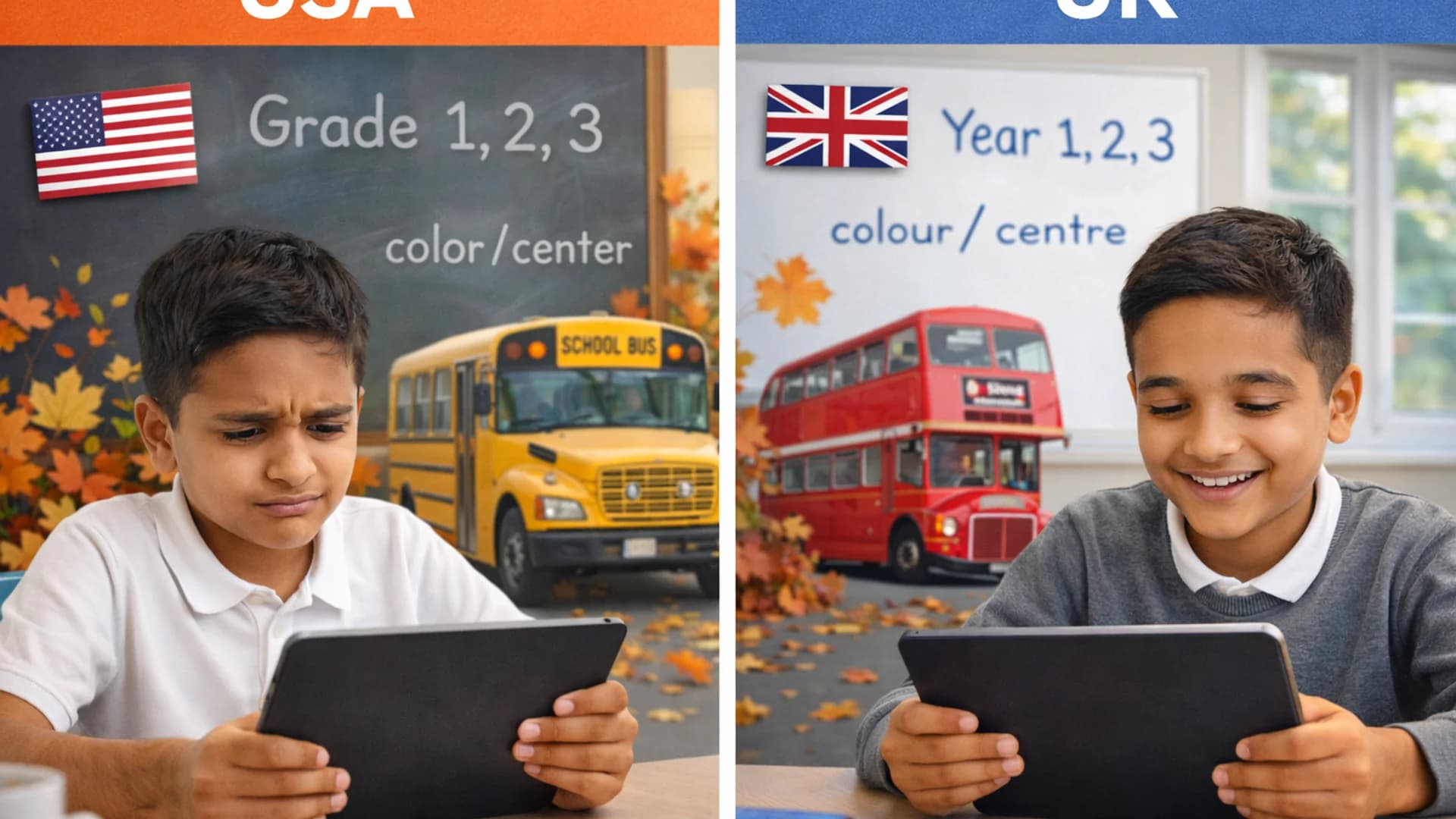
If you've ever watched your child struggle with a reading app that asks them what "grade" they're in, or rewards them for "acing a quiz" about "sidewalks" and "trash cans," you're not alone.
The digital reading landscape for primary school children is dominated by American products. Many of them are well-designed, evidence-based, and genuinely effective — for American children studying under the Common Core State Standards.
For UK children learning under the National Curriculum, they often miss the mark in ways that parents cannot easily see. This guide explains the key gaps — and what to look for instead.
The Grade vs Year Confusion — and Why It Matters
The most visible problem is terminology, but the implications run deeper than a simple naming difference.
The US uses "Grades" (Grade 1 through Grade 12). The UK uses "Years" (Year 1 through Year 13). The starting points are different too: US Grade 1 typically begins at age 6; UK Year 1 begins at age 5. So the rough conversion looks like this:
| UK Year Group | Approximate Age | US Grade Equivalent |
|---|---|---|
| Year 1 | 5–6 | Reception/Kindergarten |
| Year 2 | 6–7 | Grade 1 |
| Year 3 | 7–8 | Grade 2 |
| Year 4 | 8–9 | Grade 3 |
| Year 5 | 9–10 | Grade 4 |
| Year 6 | 10–11 | Grade 5 |
This one-year offset means a child inputting "Year 3" into an American app (if it even offers that option) may be placed at Grade 3 — one year ahead of where they actually are developmentally in the US system. The content will likely be too hard. Conversely, a child who inputs "Grade 2" to find accessible content is actually getting Year 2 material — potentially too easy.
Neither outcome is catastrophic in isolation. But when it happens consistently, across months of reading practice, the mismatch compounds. A child working at the wrong level does not build the skills they need for the year group they are actually in.
The SATs Problem: No Preparation for the Test Your Child Will Actually Sit
Here is the most consequential gap: American reading apps do not prepare UK children for SATs.
The Year 2 and Year 6 SATs reading papers have a specific question format, testing six comprehension skills that UK teachers summarise with the VIPERS framework:
- Vocabulary — understanding specific words in context
- Inference — reading between the lines
- Prediction — using evidence to anticipate what comes next
- Explain — justifying how and why the author creates an effect
- Retrieval — locating specific information in the text
- Summarise — condensing the key points of a passage
American comprehension apps typically focus on: finding the main idea, identifying supporting details, and understanding the author's purpose. These overlap with some VIPERS skills but miss several entirely — especially inference and explanation, which carry significant marks on SATs papers.
A Year 6 child who has spent two years using an American comprehension app will be confident at identifying main ideas. They may never have practised explaining how a writer creates tension or inferring a character's emotional state from indirect description. Those are precisely the skills that distinguish a working-at-expected-standard reader from one working above expected standard.
The Cultural Relevance Problem
This one is subtler, but reading researchers take it seriously.
Reading comprehension improves when children have background knowledge about what they are reading. A child who reads a text about a topic they already know something about will understand it better than a child reading about an unfamiliar subject — even if both texts are at the same reading level.
American reading apps are written for American children. The default cultural references are American:
- "Fall" instead of "autumn"
- "Soccer" instead of "football"
- "The principal's office" instead of "the headteacher's office"
- "Candy" instead of "sweets," "recess" instead of "playtime," "faucet" instead of "tap"
These are not just spelling differences. They represent a different everyday world. A child who does not know what a "trash can" is (versus a "bin") or who has never watched American football may lose comprehension points on an unfamiliar term — not because they cannot read, but because they lack the cultural context that the text assumes.
British publishers work hard to create texts that assume British cultural knowledge. American apps, by default, do not.
The Spelling and Language Standards Problem
This point matters more than it might seem. UK schools teach British English spelling and punctuation standards. The National Curriculum specifies British spellings; SATs papers use British spellings; GCSE examiners mark against British English conventions.
American reading apps use American spellings throughout:
- colour → color
- centre → center
- recognise → recognize
- practise (verb) → practice
- travelling → traveling
A child who reads hundreds of hours of American-spelled text is repeatedly seeing the "wrong" version of common words. For most children this will not cause lasting confusion — they are taught the British version in school. But for children with spelling difficulties or dyslexia, who learn spelling partly through visual word recognition, exposure to a different spelling system is an unnecessary complication.
What the App Stores Do Not Tell You
Most reading apps in UK app stores do not advertise their country of origin prominently. They use terms like "aligned to curriculum standards" without specifying which country's curriculum. They say "level" or "grade" in ways that may seem interchangeable.
Things to look for before committing to a reading app for your UK primary child:
Ask directly: Does it use UK Year Groups? If the app asks for "Grade" rather than "Year," it is built for the US system. You can often use it, but you will need to subtract 1 from the Grade to approximate the right UK Year level — and the cultural and assessment mismatches will remain.
Ask: Does it reference the National Curriculum, SATs, or VIPERS? If none of these terms appear anywhere in the app or marketing, the content has not been designed with UK schools in mind.
Ask: Is the content in British English? Read a sample text. If you see "color," "center," or "fall" used to mean autumn, the content is American.
Ask: Does comprehension feedback target inference and explanation skills? SATs questions heavily test inference. If an app only asks retrieval and main-idea questions, it is not preparing your child for UK assessments.
Ask: Is it built for the UK privacy framework? UK GDPR and the ICO's Children's Code apply to services used by UK children. American apps are typically designed to comply with COPPA (US law), which has different requirements. Some comply with both; many do not.
What UK-Built Reading Tools Look Like
A reading tool designed for UK families should:
- Use Year Groups, not Grades — Reception through Year 6, with appropriate content for each stage of the National Curriculum.
- Align to VIPERS — comprehension questions explicitly target all six VIPERS skills, including the inference and explanation questions that carry most SATs marks.
- Use British English — every word, every spelling, every cultural reference.
- Know what SATs are — and be designed to build the specific skills tested in Year 2 and Year 6 reading papers.
- Comply with UK privacy law — not just US COPPA, but UK GDPR and the ICO's Children's Code.
- Reflect British childhood — stories and examples that reference things UK children actually encounter: double-decker buses, football not soccer, the local park not the "yard," a packed lunch not a "lunchbox with a juice box."
The Broader Issue: EdTech That Exports American Education
The dominance of American EdTech is not unique to reading apps. It reflects a broader dynamic in the educational technology market: the US market is large enough to make an app viable on its own, and UK users are an afterthought rather than a design consideration.
For most categories of software — productivity tools, creative apps, games — this does not matter much. For educational software specifically designed to help children succeed in the UK education system, it matters a great deal.
UK parents deserve tools that are built around the way their children are taught, the assessments their children will sit, and the cultural context their children live in.
Frequently Asked Questions
Are American reading apps completely useless for UK children?
No. General reading — wide, enjoyable reading at the right level — benefits all children regardless of curriculum system. An American reading app at the right level will still build vocabulary, fluency, and general comprehension. The gaps are specific to SATs preparation and cultural relevance, not to reading development broadly.
My child's school uses Accelerated Reader, which is American. Should I be worried?
Accelerated Reader (AR) is a widely-used quiz system, not a curriculum-aligned comprehension programme. It measures reading level using American Lexile scores, which do not map cleanly to UK Year Groups. Schools that use AR well complement it with VIPERS-focused teaching. If your child's school uses AR as its primary comprehension tool, ask the teacher how VIPERS skills are being developed.
Is there a way to use American apps well with a UK child?
Yes. Lower the level by one Grade to approximate UK Year Group level, use the app for reading enjoyment and fluency rather than comprehension assessment, and supplement with UK-focused VIPERS comprehension practice separately. The app provides reading volume; UK-specific practice provides targeted comprehension skill development.
Why don't British publishers make more reading apps?
They do — but UK EdTech has a smaller market to recover development costs from, so there are fewer options. The good news is that this is changing. The Children's Code and increasing awareness among UK parents of the curriculum-alignment issue has prompted more UK-focused reading technology in recent years.
Ready to see it in action?
Create a story that practises these curriculum skills for your child.
See your child reading at the right level
Create a free personalised story matched to their reading level and interests.
Create a Free StoryFree to try • No account needed to start


