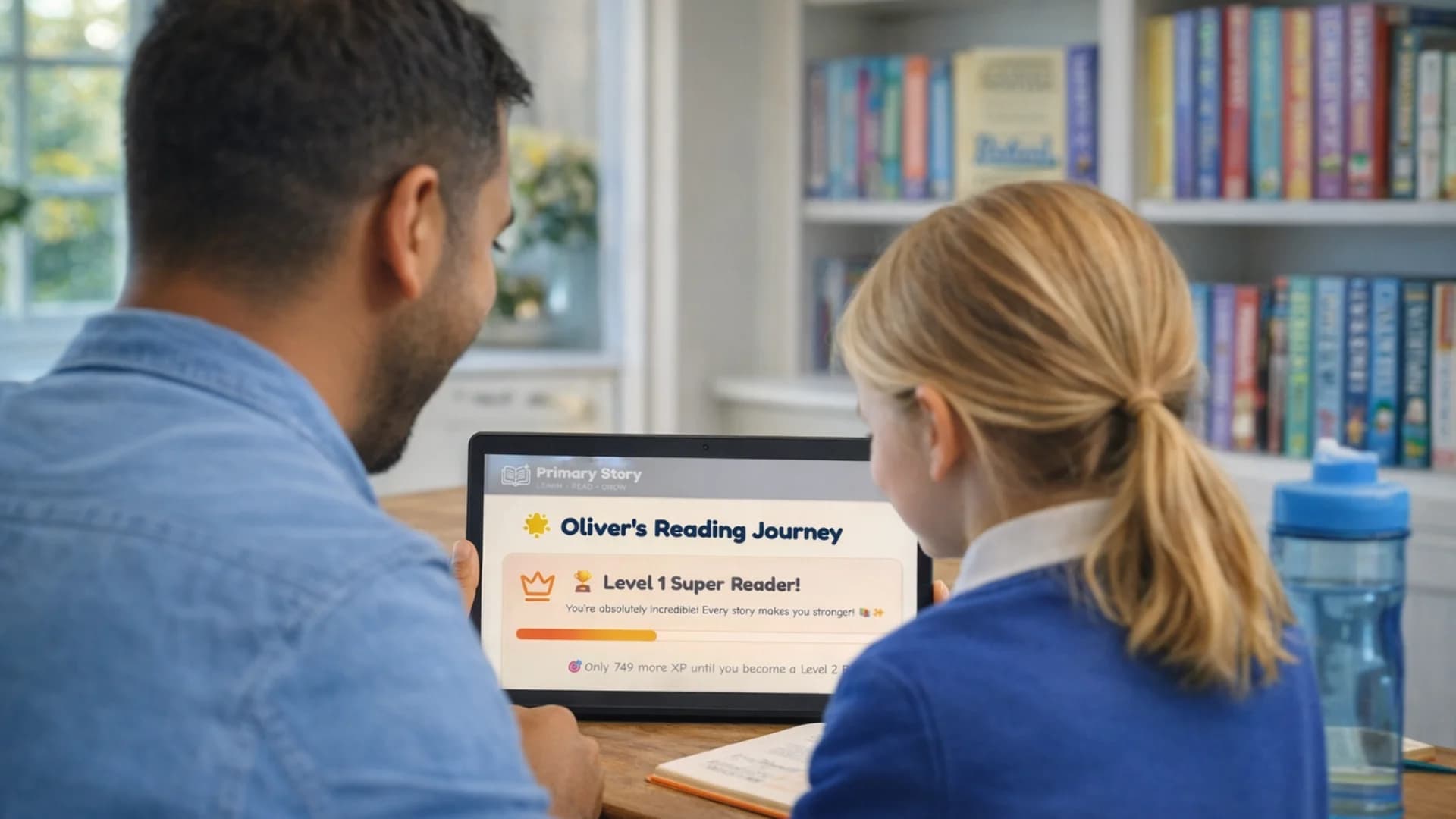
How AI Personalises Reading for UK Children: A Parent's Complete Guide (KS1 & KS2)
Discover how AI personalises reading for UK primary school children aged 5-11. Learn how adaptive stories, instant comprehension feedback, and GDPR-safe technology work together to improve your child's reading — explained for parents, not engineers.

"Will AI make my child lazy?" "Is this just another screen?" "Can a computer really know what my child needs?"
These are the questions parents ask us every week. They are exactly the right questions. And this guide answers all of them — not with marketing language, but with a clear explanation of what AI personalisation actually does for a primary school reader, and what it cannot do.
What "Personalised Reading" Actually Means
For decades, personalised reading meant a teacher or parent watching a child read, noticing where they stumbled, and adjusting the next book accordingly. It was — and still is — the most powerful way to improve a child's reading.
The problem is time. A teacher with 30 pupils cannot do this individually for every child, every day. A parent doing the school run, making dinner, and managing homework cannot always sit down for a focused 20-minute reading session.
AI personalisation does not replace this. It extends it. Think of it as a reading companion that adapts what your child reads and how they are questioned — based on what it has observed about their level and interests — so that the 10 minutes of reading they do independently are as effective as possible.
How It Works: Three Layers of Personalisation
Layer 1: The Right Story at the Right Level
The National Curriculum organises reading development by Year Group, and for good reason. The cognitive demands on a Year 1 reader (decoding phonics, building word recognition) are very different from those on a Year 6 reader (inferring character motivation, understanding authorial intent).
AI text generation can be calibrated to match these demands precisely:
- Year 1 (ages 5–6): Short sentences, CVC and common exception words, familiar settings. A story about a cat who goes to school uses exactly the vocabulary a child at this stage is consolidating.
- Year 2 (ages 6–7): Slightly longer sentences, compound words, dialogue. Simple cause-and-effect plot structures.
- Year 3–4 (ages 7–9): Multi-paragraph stories, varied sentence lengths, descriptive language. Characters with motivation and emotional complexity.
- Year 5–6 (ages 9–11): Complex clauses, figurative language, moral ambiguity, unreliable narrators.
This is called Lexile-calibrated or year-group-matched text. Human editors do this for graded reading schemes. AI can do it on demand — for a story about anything.
Layer 2: Topics That Match Your Child's Interests
Research consistently shows that reading engagement rises significantly when children read about topics they care about. A child who struggles through a passage about historical weather reports will often read fluently and with comprehension when the same vocabulary and sentence structure appears in a story about their favourite football team.
This is not just anecdote. A 2019 study published in Reading Research Quarterly found that interest-driven text improved comprehension scores by up to 40% compared to matched passages on unfamiliar topics.
AI story generation means a child does not have to wait for a publisher to commission a book about their interest. If your Year 4 child is obsessed with axolotls, they can read a Year 4-level story about axolotls — with VIPERS comprehension questions calibrated to that year group — within seconds.
Layer 3: Comprehension Feedback That Teaches
The third layer is the one parents most often overlook, and arguably the most important.
Traditional reading apps ask a question and mark it right or wrong. "Wrong. Try again." This tells a child nothing. It does not help them understand why their answer missed the mark.
AI-generated comprehension feedback can explain the gap between a child's answer and the text:
- Child's answer: "He felt happy."
- AI feedback: "Look at the sentence again — it says he 'stared out of the window without blinking.' Happy people usually smile or talk. What might staring without blinking suggest he was actually feeling?"
This is Socratic questioning — the technique good teachers use. It does not give the answer away; it redirects the child back to the evidence in the text. This is precisely the skill tested in SATs inference questions, and it develops through practice, not through being told the right answer.
What AI Cannot Do
Honesty matters here. AI personalisation has real limits that parents should understand.
It cannot hear your child read aloud. Oral fluency — the speed, expression, and accuracy with which a child reads aloud — is not measured by text-based AI. If your child decodes words silently but misreads them aloud, an AI will not catch that. Regular reading aloud to a parent or teacher remains essential.
It cannot detect undiagnosed learning differences. An AI adapting text difficulty will produce easier texts when a child answers questions incorrectly. But it cannot distinguish between a child who is disengaged and a child who has dyslexia or processing difficulties. Professional assessment by a SENCO or educational psychologist cannot be replaced.
It cannot build the emotional connection of being read to. Bedtime stories, the cuddle on the sofa, a parent doing the voices — these experiences are irreplaceable for building a lifelong love of reading. AI is a practice tool, not a substitute for shared reading.
It cannot guarantee progress without consistency. AI can make reading practice more effective per minute. It cannot make practice happen. A child who uses the app twice a month will improve less than a child who reads for 10 minutes every evening — regardless of how sophisticated the technology is.
Is AI Reading Safe for UK Children? (GDPR and Privacy Explained)
For a full breakdown of what makes an AI reading tool safe — including red flags to avoid and a parent checklist — see our dedicated AI reading safety guide.
UK parents are rightly cautious about technology and their children's data. The relevant law for UK school-age children is the UK GDPR (the UK's post-Brexit version of the EU standard) and the Children's Code (the Age Appropriate Design Code), enforced by the ICO.
What responsible educational AI providers do:
- No behavioural advertising. Children's reading data is not used to serve ads or sold to third parties.
- No training on children's content. Stories generated for a child are not fed back into public AI models. Your child's reading sessions do not improve someone else's algorithm.
- Minimum data collection. Only what is needed to provide the service (year group, reading session data) is collected — not location, contacts, or browsing history.
- Parental controls. Parents manage accounts, not children. A child cannot change their year group or purchase credits independently.
- No public profiles. Nothing your child does on the platform is visible to other users.
If an AI reading provider cannot clearly answer these questions, treat that as a warning sign.
How This Compares to Other Approaches
| Approach | Personalisation | Availability | Cost |
|---|---|---|---|
| One-to-one tutoring | Highest | 1–2 hrs/week | £30–60/hour |
| Graded reading schemes | Moderate (by level) | Always available | £5–15/book |
| General reading apps | Low (topic fixed) | Always available | £5–15/month |
| AI-personalised reading | High (level + topic) | Always available | Pay per story |
AI does not beat a brilliant one-to-one tutor. But it beats having no support outside school hours, and it is available every evening, at home, for a fraction of the cost.
What to Look for in an AI Reading Tool (Checklist for Parents)
Before you choose a platform for your child, ask:
- Does it use UK Year Groups (not US Grades)?
- Does it align to the UK National Curriculum and VIPERS comprehension framework?
- Is it GDPR compliant and registered with the ICO?
- Does it generate stories on topics your child chooses, not a fixed library?
- Is comprehension feedback explanatory, not just right/wrong?
- Is it ad-free for children?
- Can a parent control the account and view progress?
Frequently Asked Questions
My child's school uses a specific reading scheme. Will AI stories conflict with that?
No. AI-generated stories are supplementary reading — additional practice at home in your child's Year Group level. They complement, rather than replace, whatever scheme the school uses. If anything, more reading at the right level reinforces the phonics and vocabulary from school.
How do I know the AI is generating text at the right level?
A well-built educational AI tool is calibrated to UK Year Group standards by literacy specialists before it is released to families. You can also do a quick check: read the first paragraph of a generated story aloud and ask yourself whether it feels roughly right for your child's year. Most parents can judge this instinctively after a few sessions.
Can AI help a child who is significantly behind their year group?
Yes — this is one of the strongest use cases. A Year 5 child reading at a Year 3 level can use Year 3 content without the social stigma of being seen to read "baby books." The AI simply generates a Year 3-level story about a topic that interests a 9–10 year old. The content is age-appropriate in theme, even if the reading level is lower.
How much daily use is beneficial?
Research on reading practice generally points to 10–20 minutes of focused daily reading as the sweet spot for primary-age children. More is not always better — quality of attention matters. Two distracted hours will achieve less than 15 focused minutes.
Does reading AI-generated stories count as "real" reading?
Reading is reading. The cognitive process of decoding, fluency building, and comprehension is the same whether the text was written by Roald Dahl, a primary school teacher, or an AI. What matters is that the text is at the right level, your child is engaged, and they are reading consistently. All three of those things are what AI personalisation is designed to support.
Ready to see it in action?
Create a story that practises these curriculum skills for your child.
See your child reading at the right level
Create a free personalised story matched to their reading level and interests.
Create a Free StoryFree to try • No account needed to start